
In which Ilana looks up an elephant’s nostril and sleeps on Lake Kariba.
A 2004 Dear All in Matusadona
I flew out of Vic Falls on a 6-seater, with a young, bronzed pilot called Denzel. We whizzed through the big African sky and landed with a few bumps on the sand runway on Kipling’s Island. This is the gateway to Matusadona Water Wilderness – a floating camp that is moored in a secluded bay just off the shore of Lake Kariba, within Matusadona National Park in northern Zimbabwe. There we got into a motorboat and roared off to camp – a set of floating chalets in a quiet inlet, with grassy banks and acacia trees in the background.
A floating chalet conveys the sense of unreal, maybe even of surreal. And indeed, Matusadona Water Wilderness does convey just such an atmosphere. Large, twin-bedded chalets float on dark wooden planks, and gently pull against the moorings that anchor them to the bank.
The main chalet, fondly known as ‘the mother ship’ is a simple structure with a small dining room and lounge area, a deck and a plunge pool – which is basically just a cage to sift out the crocodiles! (No, I didn’t swim but others did. Why didn’t I? Well, I prefer my pool naturally croc-filled to give it a zing.) Above the lounge is a stargazing deck on which I sit now, trying to write by the light of a flickering lamp and the stars. Nothing – not the odd kabbalists or loud tourists – can dim my sense of wonder: that I am sitting in the middle of Lake Kariba with the Milky Way so clear that it slashes the sky in half, and its reflection is mirrored in the still, inky water below me. Across the water are our five floating bedrooms, their lights twinkling like earth-bound stars. On my right is the bank, dark silhouettes of trees that black out some of the lower constellations.
The cabins are roomy, with decks that just beg you to have time to sit and chill. The views from the shower and toilet are very good too – you can watch elephant showering while you do the same!
When on land, one goes on sundowner game drives; at Matusadona we go on a sundowner cruise – and the sunsets are spectacular: the orange ball sinking into the water between the stark skeletons of trees (remaining evidence of dry land before the area was dammed in the 1950s). The silence is so deep that you can hear voices carrying clearly across the water from the mother ship quite a way away.
While on one of our sunset cruises, we encountered an elephant drinking from the riverbank and our guide decided to float right up to him. He cut the engine and the craft floated silently toward the big elephant. Of course he knew we were there but I think he was a surprised as I was at the ‘temerity’ of these humans at encroaching on his personal space! I practically looked up his nostril before he reared up and walked away, shaking his head, no doubt, at the youth of today… While it’s always amazing to get that close to a pachyderm I couldn’t help feeling very intrusive and inconsiderate about it.
The other thing that bothered me intensely was the history of this Lake. Originally, the Zambezi River meandered through a steep valley filled with wildlife and villages of the Tonga people. Then in the 1950s, the then-Rhodesian government decided to flood the area to create an enormous lake 220km long and 32km wide – in 1960 it was the largest man-made dam ever built. The aim was to provide electric power and create a thriving fishing industry. While this was the case, and jolly good show and all that, the negatives are striking: the Tonga people were uprooted and their culture destroyed – they were ‘encouraged’ to become a fishing people whereas before they were something quite different. And then there were the animals who moved to higher ground as the waters rose, only to find themselves trapped on islands. Here, of course, the world was in full sympathy and Rupert Fothergill ran ‘Operation Noah’ capturing and relocating up to 5000 animals, including lion and rhino. But despite this effort many animals and – even birds oddly enough – drowned.
So for some reason – perhaps it was the skeletons of the Leadwood trees that still stand in the water after all these years, or my knowledge that this was ‘artificial’– but I was peculiarly aware of the ghosts of the animals and history lying at the bottom of the quiet lake.
Not that I let it bother me, of course.
You can go for walks and drives in the Park, but there wasn’t enough room for me on the walk so I joined Greg the guide and Kerry on a drive. It turned out to be the best decision, because as we bumped our way along the sand road, Greg screeched to a halt and pointed: two black rhino browsing not 20 metres away. We switched off and listened to the contented munching sounds emanating from these beasts while I metaphorically turned ecstatic cartwheels – my first black rhino in the wild! Not only did they not move away, they actually moved towards us, crunching loudly. You have no idea how loudly these animals eat until you hear it for yourself, but their lack of table manners just endeared them to me further. Yellow-billed oxpeckers hopped around on their backs, enjoying a meal of ticks.
Sated with this spectacular viewing, we stopped for drinks on the banks of the Kariba Dam. The camp is in a small inlet so one feels that one is on a river, but when one sits looking at the enormous expanse of the Dam, it looks just like the sea, the opposite bank almost invisible. It’s a bit odd seeing hippo on the ‘beach’ then…
Waking up on a floating chalet is much the same as in a terrestrial abode – until you feel a gentle movement under your feet that changes your perspective slightly. The utter silence makes you realise that you are far, far away from any ‘civilisation’ – no human-made noise spoils the wilderness. Then the birds begin: hornbills begin to bark, swallows to twitter and then the majestic fish eagles begin to call to each other. And that, my friends, is Africa resonating: that fluting, cold sound echoes clear across the still, glasslike water.
Of course, the stillness makes things seem closer than they are – the laugh and grunt of the hippo sounds like faulty plumbing – and he’s in your bathroom.
So in the afternoon I hung out with three elephant, a herd of waterbuck and a bright green fly. Admittedly the elephant and waterbuck were on the riverbank doing their thing and I was on my chalet deck doing mine, but we all did our thing in what I like to think was companiable silence.
I was lying on the warm planks, dozing in the sun, when I heard the sound of twigs snapping and some slurping noises. I looked up and there, not 10 metres away, was a young elephant, maybe five years old. He’s come to the edge of the water and is feeding on the young green grass growing there. But it’s all muddy, so each mouthful is taken carefully in his trunk and washed in the water before being consumed with much enjoyment. Then a little brother or sister joins him, no more than a year I would say, and promptly begins to do the ‘copy your brother/sister’ bit: he stands right next to his sibling, almost on his toes, watching him, then emulating every move. But unlike humans who by this time would be shouting, “Mom, he’s PUSHING me!” the older elephant has no problems with teaching the ‘lightie’ what to do.
A rumbling tummy sound floats over the water to me. Big mama is in the dense bush somewhere and is calling the kids. They turn around and squelch their way to dry land, melting into the bush behind them. I’m left with my fly and a warm, fuzzy feeling. I wish I knew more words – perhaps there are none to describe the experience of sitting on floorboards smelling strongly of varnish, water glinting beneath me, just the sounds of a fly buzzing, a fish flapping a fin in the water and the lip-lip-lip of water against the poles. Sometimes when the experience consumes the senses so utterly, the best articulation is silence.
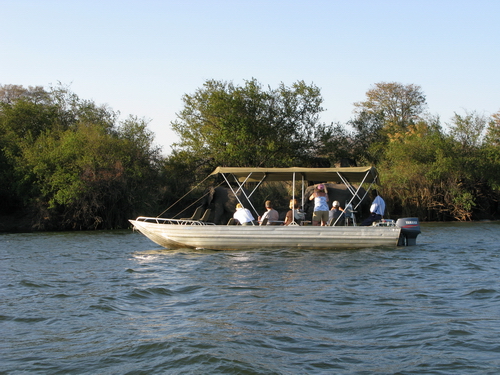
Floating in Kariba

Never miss an update!
Subscribe below and receive my posts by email.
JOIN MY MAILING LIST – GUARANTEED SPAM-FREE.
 ILANASTEIN.COM