
A 2005 Dear All, in which Ilana’s journey in Namibia ends in Damaraland, with many elephant, a Best Desert Game Drive Ever, and Shabbat on Mars – only nicer.
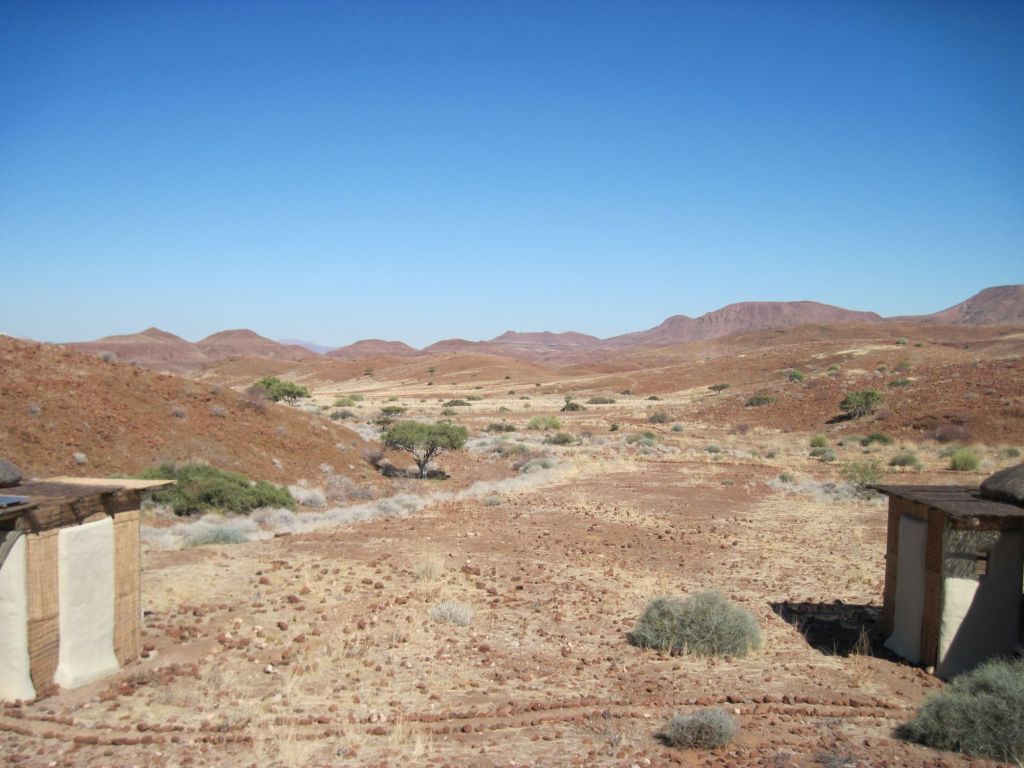
The final stage of the journey began (is that an oxymoron?) as we awoke to a gorgeous sunrise, drank a last cup of coffee, looked out over the grasses and regretfully left Palmwag on the Thursday morning and bumped our way to Damaraland Camp – fondly known as “D-Camp.” It feels like the end of a pilgrimage, one that began in luxurious abundance of water, through the drier yet still fertile grasses of Palmwag, and ending at D Camp, where the view from the camp is down into the dry Huab riverbed, flanked by bare rocky mountains on either side. No rains of any consequence have fallen in the area, so the ground is not covered with softening grass and shrubs of Palmwag. Its bare rock and sand, boldly dark red-brown, made me feel like I was on Mars, but I’m sure the Red Planet doesn’t have the occasional milkbush and shepherd tree to break the scene, or such nice people around. D Camp staff has a range of fascinating, warm characters, from Rosie, the first female black guide in Namibia, to Lina, full name Piscalina, who is extra large in size, voice and character. When Lina walks into the room, you KNOW it! She is also the manager of D camp and from the looks of things (sparkling clean; I could have literally eaten off the kitchen floor but they didn’t make me) she runs a damn efficient ship, and there was a warmth and pride in their Camp that came from everyone that was overwhelming.
Their pride is not undeserved. It’s a stunning little camp, tented of course, gorgeous stone bathrooms with forceful showers (real water once again! They get the water from a little village a few kilometres away.), delectable, large beds with snuggable duvets, and that Martian view that at first shocked me with its barrenness, but with which I fell in love more than any other. As the sun moves westward behind the mountains, one is struck again by the awesome starkness of the environment. The mountain ridges stand out austerely against the bright sky, lined with a bizarre tree called a hemelsbesem – a heaven’s broom. It has a thin trunk that ends in a few whispy branches that do indeed seem to sweep the sky clean. And the silence is louder than ever, every chirp of every bird seems to take force to break through it. I know this all of course because I spent an intense Shabbat here… but more of that later.
So, back to the people of this camp. As I mentioned, Lina is larger than life, who took to my ‘eccentricities’ with alacrity, telling the kitchen staff in Afrikaans that if they used their knives to cut my food, “sy sal vreeslik siek word, en sy kan doodgaan!” (“She’ll get very ill and can even die” for those of you who are Afrikaans-challenged.) I didn’t want to contradict her, but it did seem a bit extreme! Oh then the two cats, Thelma and Louise by name (half domestic and half wild antecedents, who themselves are “undergoing strict family planning” as Lina puts it), wander around, piling like purring rugs into laps and generally giving a friendly feel to the place. Carina is the assistant manager who kept me company on Shabbat, and Aloysius was our intrepid guide who took to our demands with admirable equanimity.
Now, this camp gets even more interesting when it comes to community conservation and ecotourism and I crave your patience for this, because it’s important. The story goes back to Apartheid times, when the South African government ran South West Africa as Namibia was known. In their infinite wisdom (not), they decided to move some tribes made up of a mixture of races that lived in Upington/Augrabies area of South Africa to the Damaraland area. (Of course the fact that people think they can just move other people without so much as a by your leave… anyway.) So a number of tribes were uprooted and dumped here, in an area that was pretty barren, since the white farmers had been moved out as well… long story. Anyway, one of the tribes, known as the Riemvasmakers, came to live in Damaraland and, although they came from a similar habitat, the local Damaras taught them many things, and now there is much intermingling amongst the groupings. Be that as it may, the area is harsh and dry, and the size of an average village is 5 or 6 shacks if that, with about a hundred goats which function as general currency and status.
However, not long ago, the inhabitants of all the little villages decided to combine into the Damaraland Community, and Wilderness helped inspire them to do it. Wilderness offered to build a camp here in the area, using local labour, staff it with local people, with the promise that the community and Wilderness would partner in the venture until the people were ready to take it over themselves, at which point, Wilderness would continue to market it, but the camp and its profits and benefits would belong to the people. Hence, the camp is staffed and run entirely by local Damaras and Riemvasmakers, who do a brilliant job. This has been such a success that the area was declared a Conservancy by the Namibian government, and in fact it and Wilderness won the World Tourism Conservation Award just recently and we’re all very proud. In order that all the people of the area benefit, all funds etc are run through a Trust, the Torra Conservancy Trust and its annual meeting happened to be on the Saturday that we were there, so Mike and Chris were able to go and watch a new kind of conservation and community in action. The people see the wildlife of the area (yes there is, wait till next paragraph) as assets, tourism as a way forward, and in fact, other communities have now come to us, asking for the same thing, as it is so successful. But I’m not going on more, cos it sounds like a publicity thing for Wilderness, but it is one of the reasons I work for this company and it means something to me, hence I must tell you about it. It gives much significance to my daily profession. See?
Anyway, where on earth was I? Oh, yes, so we settled in at D Camp, took a break for an hour to explore the area and see the Penduline Tits at the small plunge pool they’ve made in the rocks, then Aloysius took us out for a drive to the nearest village called Fontyne, meaning fountains, what a laugh in the desert. Each village in the area is in reality a cluster of shacks or broken down houses; Fontyne is an old farmhouse (white farmers once worked this land before being moved off to presumably greener pastures), a few huts, a small water tank and a dusty vegetable garden. As we arrived, it being sunset, the goats were being herded into their pens for the night. Horribly thin dogs sat watching, their ribs sticking out in a way that bothered me a lot, as you can imagine – wanted to take them all home with me. But they function as watchdogs, barking if hyaena or jackal arrive at night to feast on goat, which constitute the currency of wealth and status in this land. Quite an education for western eyes. The chief of the ‘village’ came to greet us, and a little girl in a pink dress ran away when we said hello. After sundowners were taken with a seriously stunning view, we returned to camp for dinner under the stars and a beer or many around the fire. By 8:00 we’d all collapsed!
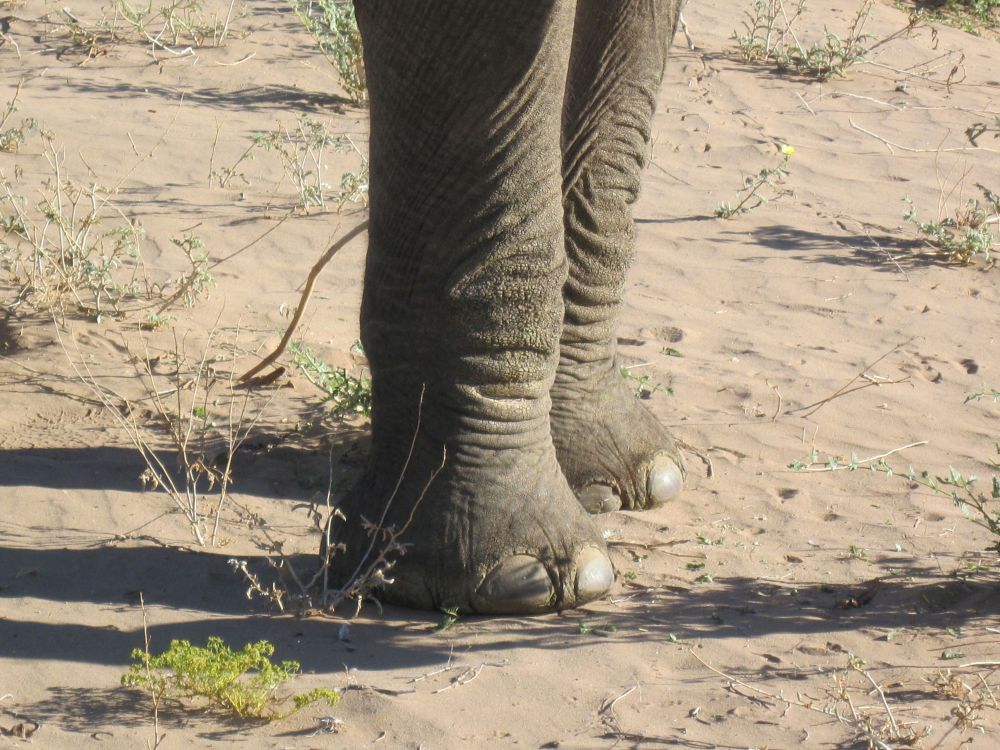
The next day, being Friday, Mike decided we needed to track down the desert-adapted elephant for photos. When the river flows, i.e. in summer, the elephant are down in the riverbed but now they had moved to the grasses near Palmwag, so off we went to try and find them. I had impressed upon all and sundry that I had to get back by 5:00 latest, and that if I wasn’t, I would be getting out wherever we were and begin walking. Especially since it’s actually much safer here than in Joburg, I reckoned I had no excuse for Pikuach nefesh and would have to do so! So it was with a certain sense of trepidation that I joined them on the trip, but they all assured me they didn’t mind getting back by sunset and we’d make it. Well, what a drive; the amount of game we saw didn’t seem to square with the fact that this was desert. We hadn’t gone far along the main road (straight and wide, but still sand), when we noticed elephant tracks crossing the road and going toward a water tank belonging to a small village. We drove up to it, noting the elephant dung on the side, and asked a man dressed in a torn shirt and satin pink pyjama shorts if he’d seen them. Yes, he said (in Damara – lots of clicks in the words) they had come to drink earlier that morning and then had gone “that way.” This is how things are here: people share their water with the elephants and live with the animals in a way that we in South Africa have lost. There’s even a village that waits for the three bull elephants that come daily to drink before releasing their goats so as not to disturb them… Which is not to say there aren’t complaints when the ellies get into the vegetable gardens. It strikes me that this is the way conservation should be everywhere.
Anyway, we left the beaten track for one somewhat less beaten and for the next seven hours we bumped and bounced along ‘roads’ all too similar to those of Palmwag. We saw those ellies: a small herd (desert elephant herds are always small because of pressure on food and water sources) that posed beautifully for Mike, walking in single file reminiscent of Jungle Book – remember? – through long swaying grass, with the mountains as backdrop and backlit by the early morning sun. We proceeded to see some agitated zebra which turned out to be agitated because of the cheetah relaxing in the shade of a milkbush, a mangy jackal, three hyaena feeding on a carcass, some vultures joining in, a lovely journey of desert-adapted giraffe, and of course by now ubiquitous gemsbok and springbok. Up hill and down dale, we ate lunch once again in a dry riverbed under a mopane, at a spot known as Poacher’s Spring – for obvious reasons. Now, instead of poachers, we saw the Rhino Monitoring guys and the field ranger unit of the Conservancy, which gave me the warm fuzzies.
Suddenly it was 2 o’clock, we’d been driving for six hours… and Shabbat was in at 5. Uh oh. Um, I asked Aloysius, so can you get me back in time? Sure, he said, but then we have to go fast (remember the roads…) and not stop. Okay, we take a decision that we’ll only stop for really awesome stuff. Excellent decision. Not five minutes later, we see a black rhino. We consider whether we have time to track it, regretfully decide no, and fly on. After more bouncing for an hour we reach the ‘main road’ and promptly see the second herd of elephant, along with five-month-old baby Rosie (Named for our female guide!), too good an opportunity, so we have to stop to take pics, then quickly, we say, let’s waai! So off we go, wind tearing through the hair, taking breath away. Oops, we come past Bergsig, main village in the area, and see a sign we have to take a photo of: “Wilderness bottle store” – as far as we know, our company doesn’t do that sort of thing but maybe one of the directors is moonlighting… On we go, screeching to a halt at an Augur Buzzard, it’s forbidden to just drive past one of those, okay, let’s go now, we bliksum off (as Chris Bakkes would say), and we’re finally getting closer to home, come around a corner – and there’s a bakkie (small truck) on the side of the road, its 12 occupants waving us down desperately; they have a flat tyre and no jack. Everyone looks at me. I say: “go change the tyre but quick as a brick!” It was done in less than 5 minutes, and we blast off out of there in a theatrical cloud of dust.
Needless to say, we made it home, hair standing on end, caked with dust, by 4:30! But, as Mike said, I had now officially introduced them to the ‘pre-Shabbat rush’ and Fridays will never be the same for them again! I had plenty of time to take that much-needed shower, get everything ready and serenely light candles in the lounge, watched avidly by Lina and company. Singing kabbalat Shabbat as the horizon darkened and melted into the sky, relaxing at dinner (my special Friday night meal of fettuccini with pesto) with good company, and sipping a whiskey while the wind meandered around the rocky hills, we looked back on an incredible day with much satisfaction; all this combined into a different yet very true Shabbat atmosphere. Once again, by 8, everyone had turned in. Me, I decided to take advantage of there being no lights on AT all, ANYwhere, and walked out a few metres from my tent, attempting not to turn my ankle on any rocks. Wow just wasn’t the word. The stars shone so clearly, in a perfect arc over me in all directions that ironically, I felt that I was in a planetarium – remember the school trips? – and the whole beautiful blazing galaxy was being shone down just for me. (The only thing missing, I thought, was that little red arrow that would move jerkily across to point at things and the disembodied voice telling me what it was….) I felt the minuteness of my existence and yet the interconnectedness of all things; trying to remember that line I once read about how everything in the universe is made of stardust; we are indeed children of the stars.
Shabbat day was a mixture of amazing silence and communion, and a sense of what it means to be an Ivri – me’ever hana’ar, that famed lonely person of faith. I joined the others for a 5:30 breakfast (halachically it was the only thing to do, no eruv there you see), and then Mike, Chris and almost the entire staff of D Camp went off to Bergsig for the AGM of the Torra Conservancy. In true democratic form, this is a meeting to which villagers from all over the 350000-hectare Conservancy come to be heard and apparently there were many voices lifted, including our very own Lina. Mike and Chris had a great day, seeing more elephant, observing the meeting and then going to see Rosy-faced Lovebirds, the last particularly grating, but there you go, such is life in the Jewish lane. My day was somewhat different but no less satisfying for all that. After breakfast and sitting on my little veranda alternately watching the Ruppell’s Korhaans honking importantly around the camp’s little birdbath, and reading parsha, off I went for a walk with Rosie. We walked up to a viewing point not far from the camp, and sat to admire the view and listen to the silence. On the way, she showed me fascinating plants (I even met a young Welwitschia again!) and the different colours in the stones and sand, altogether making the Earth’s surface much less Martian than I’d thought.
Aside from the walk and a quick chat with Catrina, I essentially had the whole day to myself in a camp devoid of human company. And it was marvellous, more, it was elevating, strange and surreal. I ate my lunch with Thelma and Louise, sharing my biltong with them, and clambered up a small hill to sit and stare at a springbok who stared back unblinkingly at me. (He eventually decided the relationship wasn’t going anywhere and went away.) It became so clear to me why many of our ancestors found it easy to talk to God in the desert. Life is cleared of all extraneous detail, whittled down to its essentials. It is only earth, and few creatures and plants. All baggage is cleared, and it’s just me and the Creator. In the late afternoon, I got up and without thinking, walked out of the camp, straight down the valley. I walked until I couldn’t see any human habitation; I was truly alone. And yet, I wasn’t lonely. I was out there with my Friend, talking to Him as I haven’t done for the longest time. Ever sung Yedid Nefesh at the top of your voice, the silence of the rocks and the whispering of the leaves joining in, all the while in the middle of nowhere? Well, now I have.
Okay that’s starting to get very odd and drippy, so I’ll also admit that when the guys came back I was like an excited puppy, thrilled to have company again. We had other guides with us that evening and enjoyed chatting over the day, looking at Jupiter’s moons through the telescope and I was introduced to coffee and whiskey, highly recommended especially for those of us who view both those as our favourite drinks.
Sunday was the last day, sadly, but you’ll be happy to know that we still did a full day’s journey in half a day, driving through to the next Conservancy, known as Doro Nawas, where Wilderness is building a camp with the people from that community. On the way, we had a wonderful game drive as usual, especially with the sighting of a whole lot of bat-eared foxes who ran and bounded through the grasses in the most obliging manner. The sight of a herd of 70 springbok grazing on the outskirts of De Riet (another main village of about 12 houses), with golden grass, white houses, green trees, purple and black mountains and the wide blue yonder made a stunning portrait that sits inside me still. We managed to go past Doro Nawas camp to check its progress, but before that, got to Twyfelfontein, where there are the most incredible ancient rock paintings and prehistoric rock engravings (petroglyphs they’re called) to be seen. We repeated the pre-Shabbat rush, bouncing and flying along, wind tying bows in my hair, only this time it was to get back to camp to get to the airstrip to fly to Windhoek to wait at the airport to fly to Johannesburg chad gadya-a-a chad gadya. Oh, sorry.
And that, my dear friends, is that, here endeth the long long lesson. And if you can’t get to Namibia (such a shame really), then at least go to the Negev and have a whirl at the stargazing awesome God thing. You’ll be so pleased you did.

 ILANASTEIN.COM