
A 2005 Dear All on How to go existential rhino tracking in three easy steps.
In which Ilana meets a black rhino called Speedy (he wasn’t) and a Welwitschia plant with more personality than most people.
As you may remember, we flew off from the furthest north in Namibia and made our way south-east where the landscape began to look like lush grassland. But it’s still desert, remember, just that it’s had good rains and happens to have basalt-based soil, so it holds water better – hence the grass and Mopane trees that make me think I’m somewhere near Letaba. We landed under a hot east wind to be met by Chris Bakkes, who could have walked straight out of a Herman Charles Bosman book, Oom Schalk Lourens with a touch of William Wordsworth, a “scholar and a gentleman” as the other Chris put it. He lost his arm to a crocodile somewhere in Kruger (I’m reading his semi-biographical novel about it at the moment – in Afrikaans, come on, be impressed, will you), and his first statement when you meet him is: Can I give you a hand? When you politely decline he says, that’s good cos I only have one, and then laughs an uproarious laugh at your discomfort. With his long blond hair, a bearded smile like a Cheshire cat, and enormous voice and figure, he is literally larger than life. One of the most positive people I’ve met, he loves his life, particularly his rhinos. Which is why we found ourselves bumping and jouncing our way across the gravel plains in search of one for seven hours the next day. And boy when they say gravel, they mean huge boulders and rocks over which the vehicle jolts as Chris changes gears madly with his elbow. In fact at one point, the other Chris hit the roof quite literally and I parted ways with gravity and almost landed a few feet out to my left, and after twelve hours of it – I kid you not – one has to wonder at the amazing human body: that my organs are all still in the same place inside me that they were in the morning is probably a minor miracle.
Where was I? Oh, yes, the rhino. But first let me tell you about Palmwag Concession and Palmwag Rhino Camp. The Concession is the result of a few incredibly committed individuals who saw how the black rhino – not exactly numerous anywhere in the world – and other animals were being hunted to extinction and did something about it. They – known as the Save the Rhino Trust – took poachers and made them trackers to monitor numbers of rhino, encouraged the local, mostly impoverished people to see rhino as an asset that they could get more money for alive than dead. The area is now officially recognised as a semi-conservation area, there are a few locally run lodges, and ours is Rhino Camp. Situated in the middle of the concession, in a valley that was ripe yellow gold with waving grasses across which hundreds of handsome Hartmann’s mountain zebra galloped, the camp is reminiscent of Livingstone or Selous, explorers of Africa. (Well, white ones. People that lived there already actually knew the place, didn’t have to explore it did they?) It’s tents, but please note that the tents are large and the beds enormously comfortable, there are still en-suite bathrooms, your towelling gowns, beautiful wooden basins and the best is that, what with water at a premium, there is no running water in the bathroom, aside from a flushing toilet. So when you want a shower, you tell the hostess, Emsie, who organises that a few minutes later, you hear a polite “your water is here,” and lo and behold, a man arrives with a bucket of boiling water to fill up your bucket shower, which has a tap and shower head underneath. If you want a cooler shower you just wait a bit…. And it makes one realise just how much water we waste on long showers when, 3 minutes later, the water is all gone!
On the first day – Monday, if memory serves – we arrived at camp just after sunset, having bumped our way along the ‘roads’ (I use the word advisedly), and after that short shower, went to sit by a cheerful fire, where Chris was regaling a group of British guests about his Italian ancestor who was at the battle of Waterloo, then a Spanish prisoner of war… I lost track but I think he shocked them out of their senses; we couldn’t get a word out of them the whole evening! Emsie was amazing with the kosher deal, by the way. She had emailed me for more details and I’d sent her the Beth Din sign, so she went into her stores and every tin that had the sign was used! She insisted that I have three courses along with everyone else. So I was treated to unusual combinations of tinned things for hors d’œuvres (good old koo), fish done in tin foil, and then fascinating desserts of banana and coconut – it showed me that kosher is really not a problem if you have someone who is happy to put his/her mind to it. The long, romantically lit table in the mess tent was evocative of Africa of old, the moon made the grasses blue, and Chris and Mike swapped bush tales (each one funnier than the next, wish I could remember some of them).
The next day, off we went rhino tracking. Well, to be honest, we track trackers who track rhino. You see, the SRT employs about 45 men who go out every day to monitor all rhino in the concession. And thanks to their presence and observations, this is the only population of free-ranging black rhino that is actually growing in numbers – and they’re not in a national park or reserve, there are no fences to protect them, just the presence of people who care. So, today, we and the guests, driven by Chris and Kapoi (an ex-tracker – his name is the Namibian pronunciation of Cowboy, his dad liked the name…), followed the tracks of the trackers’ vehicle as they wended their way from one ephemeral spring to another. Lots of upsy-downsie stuff, as we bounced our way across miles of concession for seven hours. You see, black rhino feed at night and early in the morning, have a ‘daycap,’ and turn in by snuggling up under a bush for the day. So one hopes to see them early or later in the afternoon when they’re up and about again. But the day wore on and no sign of any of them. Mind you, it wasn’t a waste, in fact it was a lot of fun because we saw our first desert-adapted elephant – the same elephant as in Kruger but these particular pachyderms have adapted marvellously to desert conditions. Ours was snoozing under a tree, languidly scattering dust on his body.
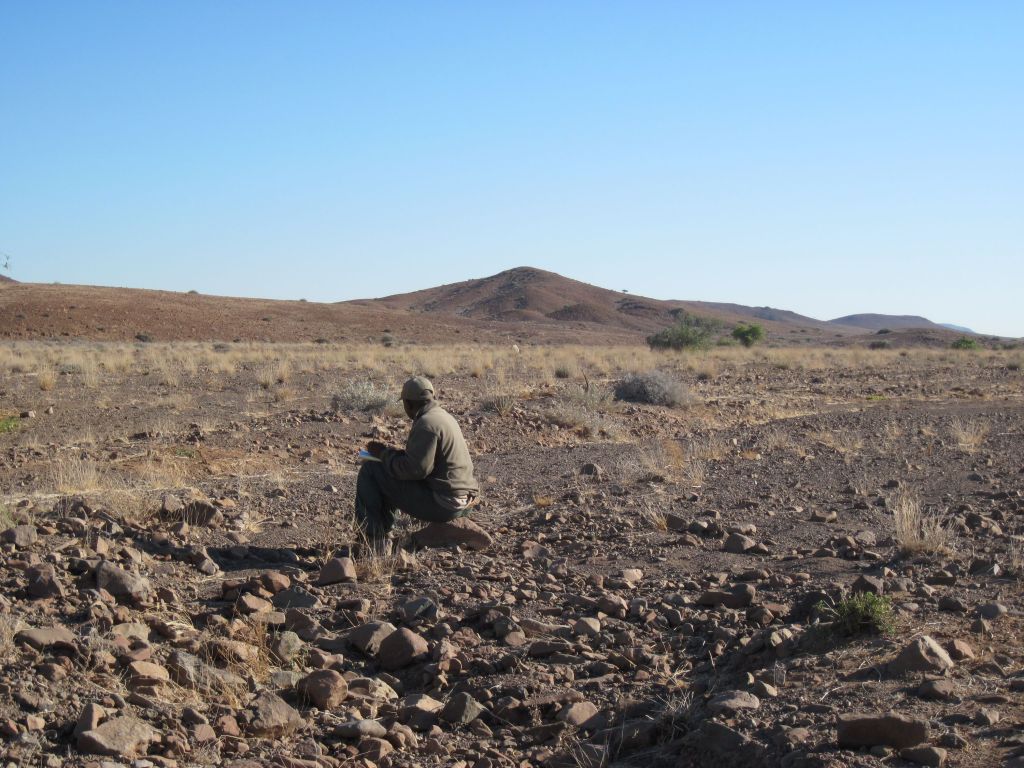
We stopped for lunch under a Mopane tree in a dry riverbed. This is an experience let me tell you. Chairs, table, tablecloth and a basin with soap and water and towel all come out from under the vehicle, then delectable food (and Ilana’s tuna salad but there you go then) and coffee, tea, cutlery and crockery, serviettes… it all magically appears and everyone settles down in the middle of nowhere for a meal fit for a constitutional monarch. We returned after this (via a herd of some 70 zebra galloping through a strong dusty wind where I felt I understood ‘desert’ more than on the dunes) for a siesta during which I sat under a tree and listened to some silence interspersed with the Star Wars-like calls of the Ruppell’s Korhaans. After fortifying ourselves with coffee, off we went again, and I was a little sceptical about our chances, but lo and behold, just before sunset, there was Speedy, our very own black rhino – the desert-adapted subspecies, Disorus bicornis bicornis! One feels quite superior about seeing one, not just any endangered black rhino, my dear… Chris, enormously excited (considering he sees them every day), leaps off the vehicle, making mad motions to us to be very quiet, because Speedy is looking myopically in our direction trying to work out if we’re figments of his imagination or just trees that have been here all along. Eventually deciding we’re trees, he moves off down into the canyon and begins feeding while we do the silent stalking thing, crouching, freezing at Chris’ hand signals, finally sitting on the stony ground to watch him (the rhino, not Chris). Chris and his team will not allow ‘their’ rhinos to be disturbed in any way, so we watch from a distance, but he’s beautiful, munching away at a poisonous milk bush, as the setting sun transforms the grass into veritable fields of gold. Eventually we make our way back to the vehicle and toast each other and Speedy the rhino with goofy smiles and sundowners.
Most people stay only two nights at Palmwag, since one day usually is enough to be able to track a rhino, and that is what everyone comes for. But we stayed an extra night and went exploring the 2nd day. As Chris got into the driver’s seat, he grinned his wide, mischievous grin at us and said: “We’re going over there” – pointing to some grey mountains in the far distance – and then, what became a leitmotif of the trip, “The safari is not over yet!” So off we went “over there.” Into the mountains, bouncing down into dry watercourses, then up again, over hills, through Mopane trees and milkbushes – the sense of exploring, of seeing just what’s over the next horizon intoxicating. In terms of game, it was a bit dry and there was a fierce east wind so strong one could almost lean against it, but we still managed to see the gemsbok and springbok that have become like impala, some kudu, a scrub hare pretending to be a rock, and a rhino rubbing post that shone blackly in the sun, like obsidian, smooth from centuries of rhino-use.
It was on this drive that I got up close and personal with a Welwitschia plant. These are enormous wonders of the plant world, part gymnosperm (cone-bearing), part angiosperm (flowering plants), they grow slowly and their trunks become stunted, so that the one we saw must have been 900 years old, but was only up to my knee. They grow only two leaves all their lives, which become tattered and torn as they grow; otherwise I guess the leaves would extend for a kilometre at least from the plant. I like old, venerable plants. They seem wise and at peace, in their sense of place and time. No rush, they say. Hold fast. Do what you’ve been put here to do. All will be well. The fact that such a plant can live in such a harsh environment for so long is amazing.
The sense of time being what one chooses it to be deepened as we steeped ourselves in this journey. We stopped for lunch – again in a dry riverbed in the shade of a Mopane – and as we sat and talked, I realised that this kind of life steeps deeply into the very bones of the body. When I thought of Johannesburg, the image that came to my mind was of a movie fast-forwarded, people whizzing, gabbling, no time… whereas here, life goes at the pace it should: one step at a time, one deep breath of clean air at a time. Time to talk to a plant and rub a rhino post. To take in the sky and wonder at the grains of sand. To sit in the shade and watch a red insect make its way laboriously over sand to an unknown destination.
But there are moments of extreme excitement too. For example, as we wended our way home that day, somewhat bruised, hair like straw and faces encrusted with dust and heat, half asleep as Chris manoeuvred the vehicle rockily toward home, and Mike was just commenting about the chance of seeing a rhino, there’s a flash of spotted cat – a leopard had just caught a dassie, and dashed over to some rocks where she settled down to devour it with gusto. We watched through binoculars as she finished her meal and cleaned herself, what a beauty she was, a youngster, we surmised. We watched in delight for about 20 minutes, at which point she got up and left us, still cooing in awe.
What made Rhino Camp so rounded an experience, though, was that at night, after dinner, Chris would move to the fire, and there he would recite poetry. He would declaim the poems of Canadian Robert Service off by heart – something about the Yukon – or he read Shakespeare, Thomas Pringle, you name it. My only regret was how tired I was; I felt enormously grateful to God, that I had been given the gift of sitting under the waxing moonlight, listening to a one-armed protector of wildlife read poetry, the crackling fire a sharp counterpoint to the infrasound bass undertone of desert silence.

 ILANASTEIN.COM