
Botswana, 2006 – In which Ilana visits the quietest place on Earth.
Why are you so afraid of silence, silence is the root of everything. If you spiral into its void a hundred voices will thunder messages you long to hear. (Jelaluddin Rumi)
Funnily enough that’s just what I thought (only not as well), when I was lying in a warm bed, looking up at the Milky Way splayed across the sky – in the middle of the Makgadikgadi Pans in the Kalahari. Yes, you read that right, I was lying in bed looking up at the stars. No, I wasn’t in a tent. I was just in a bed. A bed sitting out by itself in the middle of the flattest piece of Earth I’ve ever seen. Admittedly there were other beds scattered around, their sleepy inhabitants snuggled up against the nippy night air, but each one is far enough from the others to give me the impression that the Earth, the sky and I are alone in the universe.
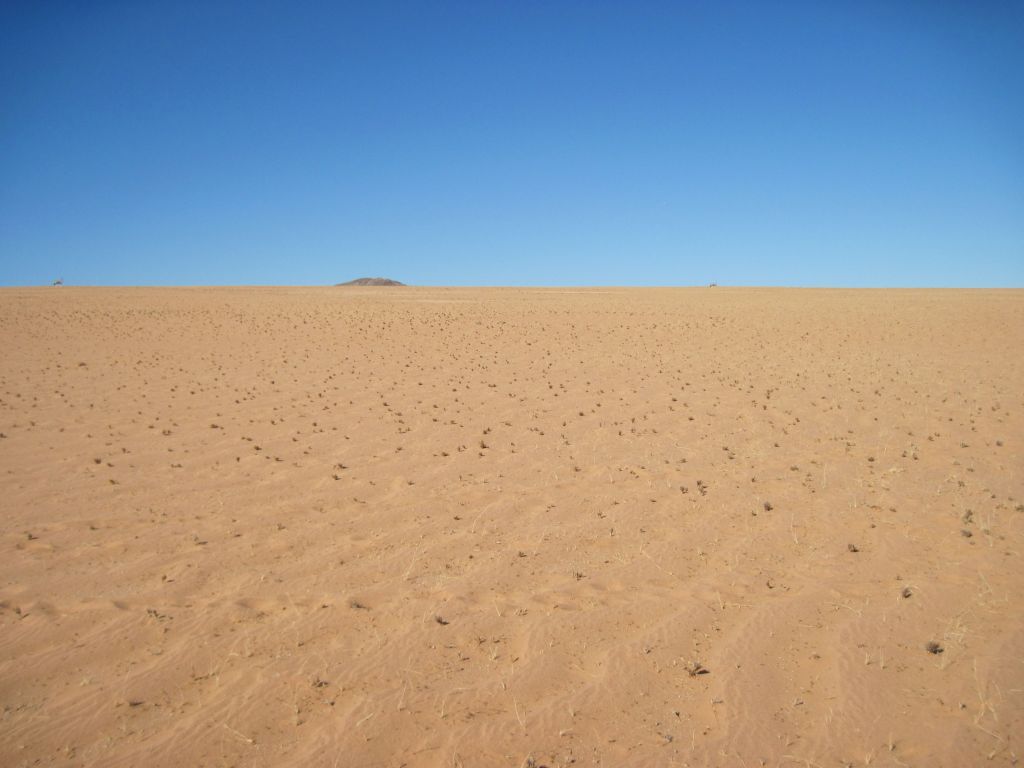
To go back to the beginning. I was lucky enough to go for a few days to a place called Jack’s Camp, which is on the edge of the Makgadikgadi Pans in Botswana. The saltpans, just so you understand, are enormous, stretching forever across a big area in Botswana, south-east of the Okavango Delta and west of the bushveld of Zimbabwe; a greater contrast to the wetlands of the Delta you would be hard-pressed to find. The pans are the remnants of a superlake that took up most of southern Africa seven million years ago (or whatever floats your boat), and then, because of plate tectonics, the earth – and the rivers – moved. Over the aeons, the lake dried up, some areas with enough water to become bushveld, river, Victoria Falls or Delta, while here it became bone dry. It’s flat as the eye can see, and covered in salty, sandy crust. It’s fun to walk on, all crunchy and crackly – like walking on bubble wrap.
That’s because in the wet season it is covered in water and short grasses, but in the dry season i.e. now, it dries up, leaving a crust of caked mud with air bubbles – and with shrimps and other small creatures that lie dormant, waiting for the rains to bring them back to life.
Yes, I know what you’re thinking. Not a whole lot of life out there then is there? On the dry pans, there is no life. There’s just us. In the day, we get there by quad bikes, by night, we’re all there is. More minimalist you won’t find.
Obviously you can’t have a camp here, can you? But of course the pans end and the grasses begin, and that’s where Jack’s is. It sits on an island (of course you can’t tell it’s an island in the dry season, but they assure me it is) covered in long, dry rustling grass, tall palm trees and other bushes – a true oasis in the desert. Even though it’s the dry season now, there was so much rain recently that there was still water in front of the camp, and some leftover flamingos – in the wet season hundreds of thousands of the pink birds arrive and wade the salty waters, as well as – get this – the second largest migration of wildebeest and zebra in Africa, thousands of them moving through the short, seasonal grasses. We missed them by not much, sadly, but there you go then.
We also missed the other major animal sightings – the brown hyaena were denning but went all shy and retiring on us, so we never did get to see them even though we sat near their den and sipped beer patiently for an hour. We also missed my personal favourite: a habituated troop of meerkats. Apparently you spend the morning with them, just hanging out with the cute critters while they do their life thing, scrabbling for insects, alarm calls at raptors, socialising… Ah well, another time.
But let me tell you more about the camp. It’s just stuffed full of personality. The history, on one leg, is that in the 1960s, Jack Bousfield established a camp in the area where his father and grandfather had explored and hunted. Jack’s son Ralph has taken it over, called it after his father, and his blue eyes glitter with enthusiasm when he shows us around his home – and he really does consider it as such. Personally I’ve never seen a home quite like this but that’s all part of what makes this place so different. It is in fact a museum, a place dedicated to and evoking the past – of his own family as well as of the country in which he lives. The lounge, dining room, billiard room and library areas are cluttered with glass cases filled with bones, fossils, egg shells, stuffed animals, and Stone Age tools. Old, faded photographs and drawings cover the walls; furniture is of heavy, dark wood. The canvas material is, oddly enough, pink with a starry design; this is apparently a copy of the officers’ mess in the tents of the British Army. Even if pink and fossils aren’t your thing, you have to appreciate the vision behind it – of the importance of preserving or remembering our history, both personal and as a species.
My tent is at the end of the island, a long walk on narrow sandy paths with waist-high dry grass rustling on either side. I love the dark wood, the four-poster bed, brass basin hidden in a writing desk looking thing, outdoor shower under a palm tree (but of course!) – and the toilet that looks just like a large armchair! The view from the tent is just right for awe and contemplation. My eyes need a wide-angle lens to take in the proverbial sea of grass, stretching to the horizon that is perfectly round, edged with palm trees where the sky comes down to kiss the earth.
Our first afternoon had been the brown hyaena-less game drive, although we had seen a variety of larks and pipits, amazing Black Korhaans, jackals and ground squirrels – large, gopher-like, not at all what I thought they’d look like. Our guide, appropriately named Super – and he was, super-sized 6 foot 10, super guide, super smile – knew everything, and exuded a calm assurance that all was well in the world (that’s why I like the desert, you’re so far away from the madness of the reality of human “civilisation”).
You’re woken in the morning by a gentle call and a silver tray on which sits a pot of steaming coffee in a tea cosy (or is that a coffee cosy?), cup, saucer and biscuits. When asked the night before if I wanted coffee or tea, I turned up my nose at this “uber-safari” concept, but I must admit that when it arrived the next morning I rather sheepishly enjoyed it….
On our only morning there we went off for a walk with four Bushmen. Apparently you can call them that, I thought it was insulting but they say not and they should know. I can’t remember the names of the four except Cobra, a man who looks older than his 65 years in typical Bushman fashion; his face wrinkles have wrinkles of their own. He’s called Cobra because he loves snakes and if you find one in your tent, he’ll come and lovingly take it away. And no, he won’t kill it either and won’t talk to you again if you do. The other three had names with those complicated clicks and tsk sounds – spelt with // and ?s in them. I think one was called //am. Or perhaps it was ?am.
I’ve never met anyone more at home in their environment. They carried spears and steenbok skin bags, and walked with a swinging gait which they can keep up for hours; next to them I felt ungainly and out of touch with my surroundings. They stopped often to show us tracks and dung, dig up tubers and other roots, explain the uses of the plants and tell stories of the animals. Did you hear the one about the Yellow-billed Kite who once lent a needle to the chickens?
Well, they lost it. The Kite was so angry he told them that until they found it he would hunt them from the air. Since then, you see chickens pecking in the dirt looking madly for the needle, while the Kite hovers above them…. It conveys perfectly the frantic pecking of the fowl, the silent soaring of the raptor – and their relationship.
They made fire using sticks (we wanted to offer them a match but it seemed a bit unsporting) not just to demonstrate this amazing art, but to smoke their home-made tobacco, and showed us how they made a trap for birds with the fibrous bark of a baobab tree. We walked for hours under blue sky and hot sun, the gentle clicking of their language rolling over and around us.
It was while watching Cobra and the others make their fire that I realised that this place stands firmly on the edge of yesterday. From the pans that took seven million years to be what they are today, to the historic quality of the camp, to the Bushman way of life that is preserved and celebrated, the camp and what it represents thrives on nostalgia and on all that was good of the past. (Having said this, we all know that “the good old days” concept classically ignores all those pesky little details which we won’t go into here.)
In the afternoon the quiet past meets the roaring present – quad biking through the pans. But before we roar off into the sunset (well, to the left of it to be exact), we have to have the correct headgear – a kikoi that is wrapped Bedouin-fashion around the head. A kikoi is a brightly coloured piece of cloth also known as the ‘Kalahari cooler’ since in summer all one can do in the incredible heat of over 45 degrees Celsius is lie in your tent with a wet kikoi over you to catch the breeze. The aim now though is to keep the dust out of our hair, and to make us feel like Lawrence of Arabia, the ends of the fabric whipping and rippling in the wind as we roar down a narrow track that stretches crisply through the whiteness to the end of the world. (We have to keep to the track so that we do not destroy the fragile environment of the Pans, of course.) All around me there is only whiteness and flatness all the way to the deepening sky – 360-degree emptiness.
We stop for sundowners, watch that red sun slip spectacularly under the earth, and play games with the nothingness: try walking straight across the pan blindfolded – most of us curve one way or the other, some almost turning a complete circle. At dusk, we all take 150 steps away from each other, lie down and watch the stars blink on one by one. The silence is so intense that I swear I can hear the Earth humming to itself as it turns on its axis.
On our way back to camp, we see a roaring campfire just off the track. Gosh, says Super in mock surprise, what can that be? Gosh, it is a place to stop for pre-dinner drinks and then dinner – a three-course succulent repast that is brought and made right out here in the middle of nowhere.
But wait, there’s more. On the pretext of showing us a fossil hippo, Super leads us out into the darkness (the fun bit here is that you don’t need a torch to light your way, you can walk for miles in pitch darkness and not bump into anything – except other night-vision-challenged humans of course) and springs the greatest surprise of all: Beds set up, spread out from each other, complete with warm duvet, pillow, and hot water bottle, squatting oddly in the space and the silence. It’s easy to know which bed belongs to you, because your toiletry bag or toothbrush is on it… There’s a fire, a toilet, and the guides keeping watch, but that’s all quite a way off, making us feel safe, yet intrepid – great combo.
Some people stayed, others opted to return to camp – me? What a question. The chance to snuggle down in a warm bed and see more stars than you’ve ever dreamed of, to struggle to stay awake and watch the Scorpion turn and slide down towards the edge of the globe, to feel the silence reach way down inside of me – does not come along often. The whole Planetarium spread out above and to each side of me – before long, the eyelids drooped and I felt myself spinning through the universe amongst those twinkling, whirling suns…. And then before you know it, it is morning. I don’t have to move much to watch the sun rise, and the colours seep into the world again. (And wave blurrily at Rob and Chris somewhere in the distance.) Then, stumble off to the fire, and grab fresh coffee and muffins… it doesn’t get much better than this.
And in fact, it didn’t, because we had to swiftly quad bike back to camp, (that was COLD!) quickly shower, grab breakfast, say goodbye, and charge bumpily to the airstrip (although en route, we did screech to a halt for a caracal) to get on the plane to wing our way regretfully to Maun and then Johannesburg. Sigh.
When I need space to breathe, and silence to hear, I now know where to go.

 ILANASTEIN.COM