
Rocktail Bay, South Africa, 2006 – In which Ilana finally gets to meet several large sea turtles at the dead of night, wander through a coastal forest and contemplate life as a beach.
It’s odd how the closer a place is to you – geographically speaking – the longer it takes you to get to it. I’ve been to some of the most remote places in Southern Africa, but it took me two years to get to Rocktail Bay in KwaZulu-Natal, a mere 7 hours’ drive from Joburg! Go figure. But the wait (and grumbling “when you going to let me go see the turtles yadda yadda”) was worth it, I must say.
It may be closer than Namibia say, but it is still a bit of a drive to get there – all the way via Ermelo, Bethal, Piet Retief, Pongola, Jozini and many potholes, goats and wandering pedestrians later you’re in the Greater St Lucia Wetland Park. The place is surrounded by a nature reserve on land (a World Heritage Site no less) and the Maputaland Marine Reserve at sea. The only people around besides guests and staff are villagers from the nearby communities who come to fish or collect mussels on the seashore, or graze their beautiful Nguni cattle in the coastal grasslands. Did you know that there is a different name for every cow/bull depending on the pattern on its hide? For example, a cow sporting a speckled brown-and-white configuration is called “Plover’s egg” – because the pattern matches that on the eggs of a Plover. See?
But I digress. Rocktail Bay Lodge in fact was Wilderness Safaris’ first lodge, bought over in 1992, 10 A-frame chalets perched high on wooden decks in the tree canopy. There’s an enormous vegetated dune – second highest in the world they say – along the coast here, covered in lush vegetation, so the camp is built in this forest but on the landward side. I love forest chalets – you’re surrounded by twirling, dancing leaves that turn to shifting, dappled shadows and sunlight as the sun moves across the sky. Branches and brown mulch-covered ground peek between the green of the foliage. This is even better in the outdoor shower – but you knew I was going to say that, didn’t you. I discovered that having a shower with elephants in the background is almost bested by having a shower in the midst of waving branches, whipping leaves and the chirping of birds, sunlight lapping one’s back – I kept thinking I was in a natural waterfall somewhere in the woods.
The bedroom is simple – feels like a tent and not too many windows which presents a challenge on cloudy dark days. But the service is always outstanding – yep, with the coffee in the morning delivered to your door, boy I’m getting used to that! A family of bushbabies was living in the roof, which is only sweet in the daytime when they’re sleeping. At night, their parties tended to be noisy, with lots of scurrying around, chirps and yells, loud rap music, swearing….
The view from the deck is that rippling multitude of green and brown, but in fact was aural rather than visual, surrounded as I was by the sounds of many, many birds yelling – the Red-chested Cuckoo shouting “Piet my vrou!” (a bit of an insomniac he was, going on a bit about Piet at night as well), a Sombre Bulbul telling Willie to come out and fight, and the rasping call of Purple-crested Lourie – all overlaid with Christmas beetles sassily attempting to compete. At night the reed frogs take up the chorus (and those bushbaby jollers). I took advantage of this deck whenever I could, whether early morning revelling in Wilderness coffee, or afternoon, watching the sun sink behind the next dune forest, the hazy light sending shafts of gold through the leaves and branch silhouettes. Great for contemplation and to try and improve my bird sound identification; the problem is, typical of such a lush environment, you can’t see the birds for the trees, only hear them.
Then there’s the faint tang of the sea that wafts over the dune, mixed with a scent of wood of deck and chair. This smell brings vividly to mind long-ago family holidays, you know, the ones with endless sunny days, sand in your ice cream and peeling noses. The ones with golden memories of sand castles with complicated moats getting flooded by the tide, brightly-coloured buckets and spades, being buried in the shallows, scrabble played on rainy days (okay so there were some) – do you remember?
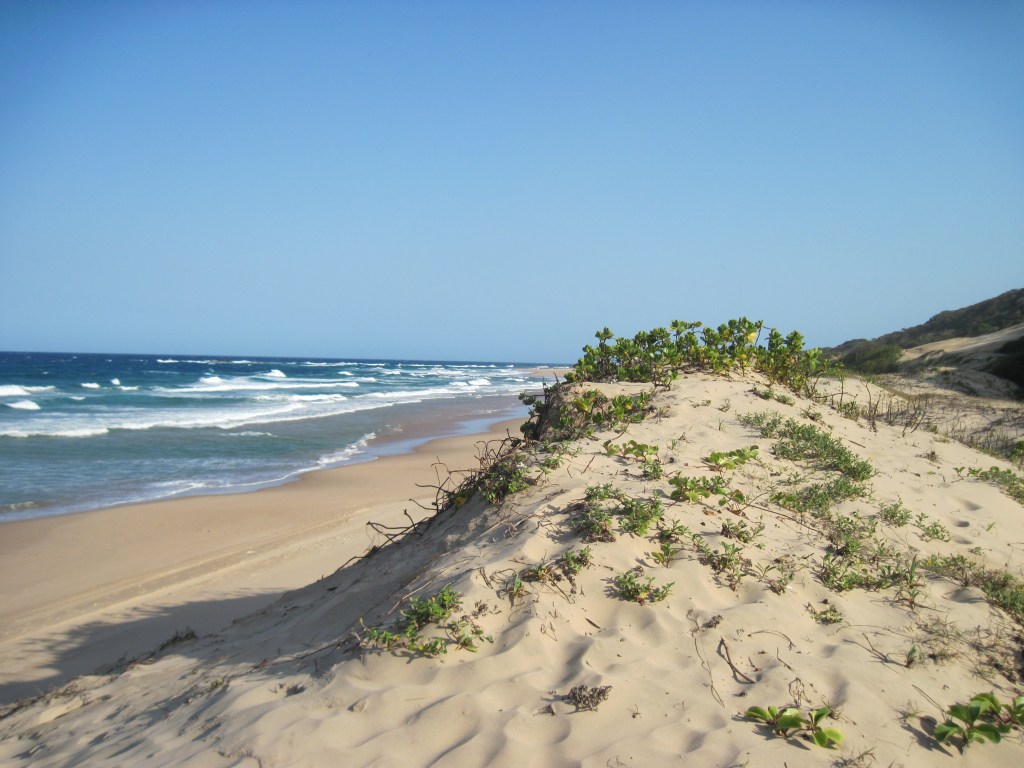
Got carried away there, but Rocktail brings a lot of those memories back. The beach is just over the dune, so first chance I could, I grabbed sunblock and set off up the steep boardwalk through the forest, over the crest of the dune, and down. There was a bit of difficulty when I was almost sidetracked onto the Forest Walk or the Hammock Trail (great idea: a shady walk through the forest with little side paths that go off at intervals, at the end of each of which is a hammock or two strung between two trunks in a clearing. If you like the look of that particular glade you merely put up the “Do not disturb” sign at the head of the pathway and tumble into the hammock with a book or just doze), and of course I had to identify several birds along the way which took a bit of time… but eventually the boardwalk ended in white sand, the trees gave way to the thick, fleshy grey-green leaves of coastal plants, and over the rise – there’s the sea!
And what a sea it is. This is a 40km-long private beach, so there are no houses or jetties or golf courses or other vital elements of civilisation to interrupt the line where bright green meets sandy white-gold, which then in turn gives way to blue and white-flecked ocean. Far in the distance to my left I could see a fisherman, but to my right – not another human. Imagine the only company being the roar and suck of the ocean, a few Sanderlings trotting along the shoreline and a lone Fish Eagle battling the wind.
Anyway, I’ll stop raving about ‘just’ a beach and tell you other stuff you can do there. There’s a trip out to Black Rock, which is a fossilised sand dune eroded in pointillism mode, a protrusion on the endless smooth sandy beach. I sat as the sun went down, just me, a bleached log, and 40 ghost crabs working the intertidal zone. Whenever I stood up or turned my head, they stop, eyes on stalks popping in terror, then scuttle off on tiptoes, reminding me irresistibly of 8-legged Victorian ladies lifting their skirts to hurry away from an unladylike scene.
Then there’s Lala Nek where you can snorkel amongst a great assortment of fish – including eels and devil’s firefish (It’s also a great place for a beer at sundown.), the Hippo Pools where a large pod of these mammals hang out – very weird seeing hippo at the coast! – and a visit to the community.
There’s also a trail through the forest, into the grasslands and then back to camp along the beach. This was spectacular, complete with perfect day, hot hot with blue blue sky so that the forest was shady and the grasslands searing, snake in the grass, birds on the wing and lots and lots of trees to get to know – Gugu was my guide and knew them all.
But the piece de resistance, if I may be so bold, is the Turtle Drive. Bit of background: On this stretch of shore, for the last aeon or so, during the summer months, loggerhead and leatherback sea turtles drag themselves up the beach, find a good spot and dig a nest where they lay a hundred or so eggs at a time. A couple of months later, these hatch and the phenomenal sight of hundreds of turtle lighties scrambling down to the sea takes place. Of course with birds and lizards and everything trying to eat them there’s the survival rate of two in a thousand but that’s Mother Nature for you. Those two, if they’re female, will return to this selfsame beach to lay their eggs in turn and so the cycle continues. Of course lately, humans think it’s really intelligent to either dig up the eggs and eat them, or decide turtle meat is delicious or just get the turtles caught in fishing lines, so of course the turtles are endangered. But not all humans: since the 1960s, the Maputaland Sea Turtle Project has been hard at work monitoring every turtle that arrives on the beach, tagging them, counting, protecting the nests etc. When the project ran into financial difficulties, Wilderness guides started doing the monitoring – which means that every night from October to December, at low tide (so as not to damage the beach too much by impacting the sand and its delicate life forms, we drive below the high water mark, see), intrepid guides – Gugu, Andrew or Mbongeni – drive a 30km stretch of beach to count and tag turtles. Every night. No matter the weather. Or the fact that they put in a full day guiding. Such commitment is sterling and rare. And if any guests want to come with, they’re welcome to. Do we want to?! What a question!
I ended up on three drives mainly because I can’t keep away when there is once-in-a-lifetime stuff happening. The first one I was too tired to appreciate as low tide was from 10:30 to 1:00 and I’d had no sleep the night before: we saw eight loggerheads (I was muttering “turtle shmurtle” by the eighth admittedly) and a gorgeous leatherback (measuring an awesome 1.9 metres long – now compare that to your pet tortoise!) just finishing nesting. She was promptly ‘adopted’ by a 12-year-old kid and his mom – for 500 rand, you can adopt a turtle and this helps us fund the project of course. And the third night there were like 24 or something, I lost track and then the sun rose and we saw Fish Eagles on the beach and you know how I get sidetracked by birds. But second night was not just successful from a turtling point of view but highly atmospheric – almost Tolkienian in its tempestuousness. (I wrote this up on my deck one golden afternoon, and the contrast between it and the ‘dark and stormy night’ may account for rant – apologies.)
When we set out – 11:30 this time; we’d had time for an hour’s snooze after convivial dinner beneath the Natal Mahogany tree – the stars had disappeared and low, grey clouds began to press down on the air – even in the darkness we could see their grey-blackness as we bumped down in an open game drive vehicle to the beach. As the headlights lit the way ahead of us, the sands seemed grey-brown and there were eerie, bright white blobs darting here and there – the ghost crabs living up to their name. Shame, those in the path of the oncoming vehicle didn’t quite know what to do: darting this way and that, they clearly were unable to work out which way lay safety. They’d dash left, then right, then left-RIGHT LEFT LEFT – then just give up and stop – right in the way of the wheel of death, aaww. I imagine their bulging eyes on stalks squeezed shut as they think: Oh no here it comes… thunk.
A kilometre along, we came across the first loggerhead. Loggerheads are not as big as leatherbacks, sort of ‘medium-sized’ – meaning it averages 1 metre in length and weighs up to 140kg – and its shell shape seems a cross between a torpedo and a tear-drop. This one was just finishing patting down the sand over her nest and while her large flippers were still carefully arranging the sand so that it is somewhat camouflaged from all those predators, Gugu quickly measured her and found that she’d been tagged before. Much excitement as her tag number was BB471 – turns out she was tagged in 1991, which means she as at least 20 years old at that point, so we’re talking old mama by now! (By the way, even these ladies are incredibly strong – once they start moving, even if you hold on with all your might, they can drag you down to the sea with them!)
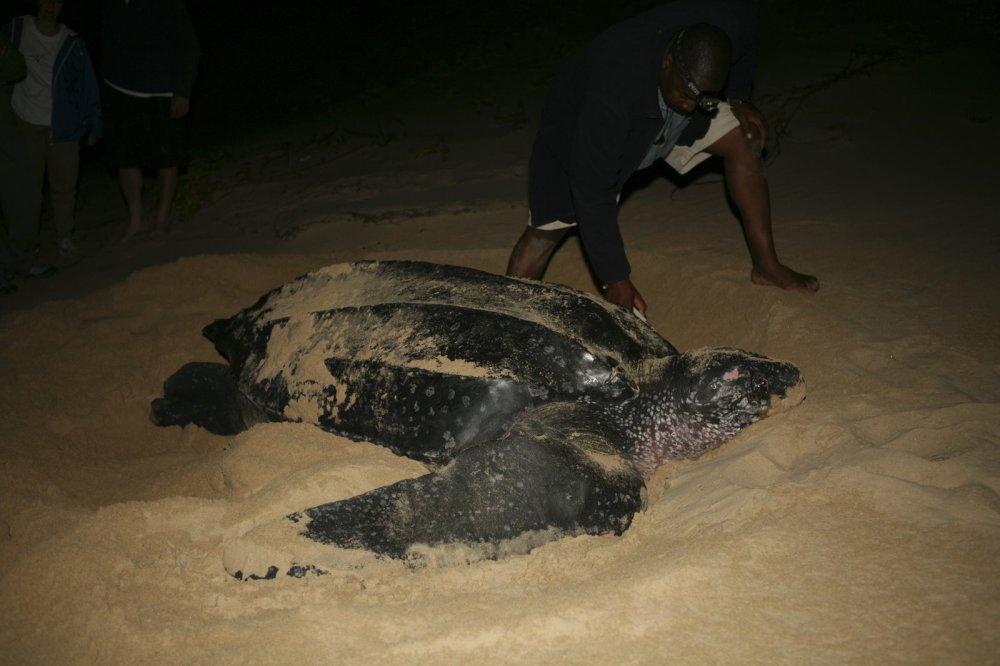
On we went, dark sea and foam on left, white ghost crabs all around us, when we saw a large leatherback just finishing her nest. Ah shucks we said, but it turns out she was just playing with us, making a fake nest to draw off predators, and the real work was just beginning. She chose a site and began painstakingly digging with her back flippers – remember she can’t actually see what she’s doing – it’s all done by instinct and feel – as we piled out the vehicle and made our way stumbling over the dark sand to her. By the way, these ladies are bigger, with elongated, streamlined dark grey or black shells – they average 1.2 to over 2 metres and weigh up to 750kg! Nice turtle, good turtle…
Meanwhile, the rain began, and lightning lit up the scene as we rushed to the vehicle for ponchos. Wilderness has these great ponchos – waterproof on outside and blanket-like on the inside, with hoods – which turned out to be vital because the rain was coming down in big ploppy drops, which the wind threw at us from all directions. Ignoring all this weather, we gathered in a respectful circle around the leatherback, as Gugu took measurements and tagged her both with a metal tag on the flipper and a microchip. When leatherbacks start the nesting process they aren’t disturbed by anything, in fact, they go into a trance of a sort and don’t notice any clipping and flashing happening around them.
And obviously they don’t care if they’re getting wet either. So there we stood, like some kind of weird cult in our hooded cloaks, rain pouring down, lightning doing the special effects monster house mood thing. In such atmosphere, it seemed to me that we were priests or supplicants worshipping the Great Mother Turtle, representing of course Mother Nature herself, the miracle of birth and beginning of a cycle of life.
The pounding of the waves and the lightning echoed the raw creation of life on Earth as it crawled out of the sea millions of years ago – and as this ancient animal created new life herself, releasing billiard ball-sized eggs gently into the hole she’d dug. This image became stronger as we all took turns to kneel down to see her drop the glistening eggs, making obeisance to motherhood and to life itself as our shoes filled with rain and sand.
(Of course the other image that came to mind was that of the Great A Tuin herself moving through the multiverse with four elephants on her back and the Discworld on that – but if you haven’t read Terry Pratchett I can’t help you here.)
She laid about 70 eggs or so, and then began slowly and with infinite care and patience filling the hole with sand, patting it down firmly. I marvelled at the effort she took with every stroke of her flippers. By now we were impatient, but that could have been the fact that it was now pouring buckets. We eventually gave in to the elements and, leaving her to finish off, we stumbled back to the vehicle. Remember this is an open vehicle so you sit down SPLAT into a puddle on your seat. Gugu drove a while longer (he has to do the full 30km for it to be a scientific monitoring system) but couldn’t actually get any further in the driving rain and decided to turn back for home – to our heartfelt relief. On the way back, the rain and lightning continued unabated and in fact continued all through the night, but you know what they say: there’s nothing like snuggling into a warm dry bed with rain drumming on the roof after a good turtle sighting!
Of course I haven’t described the other activity that Rocktail is known for and that’s the diving on reefs where no-one else is, swimming with dolphins and whales and even whale sharks, but that’s because I didn’t get to do any; combination of bad weather and not getting my act together. But please God I hope to return to Rocktail soon to make sure I’ve completed ALL the activities (including that Hammock Trail, never did get to do that), not acceptable to leave it in the middle, right?

 ILANASTEIN.COM