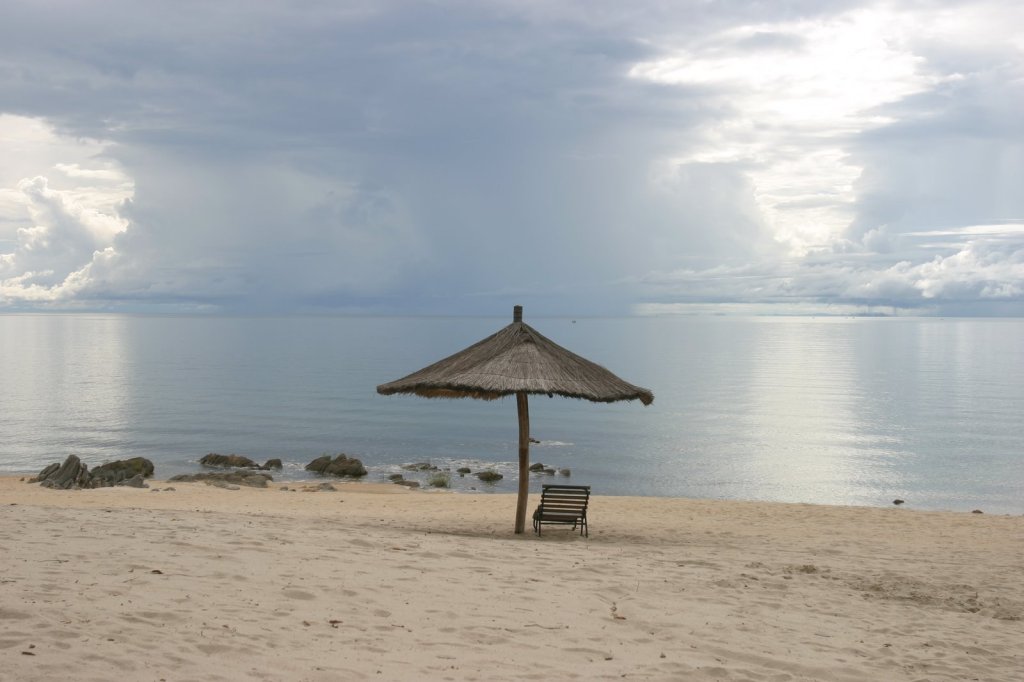

2008 – In which Ilana visits Malawi in the rainy season and spends time with Children in the Wilderness, and some other lovely people, hippos and birds.
“’Tis the season to be rainy…” This version of the song went through my head during my ten days in Malawi. See, ’twas the rainy season indeed – and the thing about the rainy season in almost central Africa is that it tends to well, rain. A lot. To make things a little um wetter, this rainy season was rainier than most apparently (something that the whole of southern Africa has been experiencing actually) so that my overall impression of the country was one of water – from Lake to River to heavy skies and muddy puddles; the sounds were musical drips and plops. Not that that put a dampener on my trip at all har har.
I landed on a (grey, rain-speckled) Sunday afternoon in Lilongwe, capital of Malawi and immediately began to enjoy the quirkiness that is Malawi. Lilongwe International looks like many other African airports – one, simple large building – and the plane came to a stop about a two-minute walk from said building. But when we alighted, we were told we had to wait for the bus. Somewhat bemused, we watched as the bus left the airport building – just over there – and drove around to us. Then some of us didn’t fit in so we had to wait for it to come back…
Lilongwe is another typical African city, with spurts of ‘city’ interspersed with suburbs and maize fields. When I was ‘in town’ I stayed at Heuglin’s Lodge (named after the White-browed Robin Chat, confusing I know, but that’s its new name – it’s still a beautiful bird with a gorgeous deep orange chest, striking white eyebrow and delicious song), a large rambling house in the suburbs that feels like I’ve wandered into a grandmother’s home and have ended up in one of her many bedrooms. Between its old-style cupboards, highly polished wooden floors, wrought-iron bed posts and Tammie, who plays the grandmother part very well – I could just relax and potter in the garden checking out the birds….
I was a bit impatient, as I just wanted to get going, you know, get to the Children in the Wilderness (CITW) programme – until I realised that this is the real Africa – where things take a bit longer than you’d expect, and we’d go when we went!
Finally on Monday afternoon (after I had pottered around Lilongwe, seen memorials and markets) I found myself travelling along the potholed roads with Gladys, (programme coordinator of CITW for Malawi) with a bucket of chickens covered with ice cubes in the back seat. Apparently this isn’t a custom of the country, it’s because they didn’t all fit into the freezer box she had, and she had to get 50 chickens to Chintheche Inn where she was running the next CITW camp. Good thing she was picking up chickens cos then I got a ride too but at least I didn’t have to sit in the bucket.
Driving through Malawi is like being in the Emerald City in the Wizard of Oz – remember how everyone had to wear green-tinted spectacles? Here you don’t need the spectacles because the country is bright green everywhere, except for the lake which is a blue-green. Of course when I comment on this to Malawians, they all crack up laughing at my naïveté – during the dry season (April to November) this country is brown and dry!
Can’t imagine it myself.
Everyone rides on bikes here and the bikes carry everything, from bags of charcoal, chickens (these ones seemed to be alive, as opposed to ours which were frozen and in polystyrene from Shoprite), piles of clothes and I even saw a man with two goats on his bike rack. They looked a bit seasick, but goats generally don’t look happy with the world. Mind you, there are lots of goats in Malawi, some with distinct suicidal tendencies as Gladys drove at 100km or so an hour, avoiding potholes and goats with equal calm. My yells at several near-misses just made her crack up laughing. Quite a jolt for the lily-livered mzungu (white person) as she chats to me, swerving around a bike that just popped out of nowhere while she’s passing a massive lopsided truck and a suicidal dog wanders into the road on the right. All this while humming to strains of “Jesus is my friend…” playing on the CD.
Meanwhile, the countryside is a patchwork of maize fields dotted with low mud, thatch-roofed houses – there is no electricity out in the rural areas, only in the towns (which, considering the whinging of South Africans, makes one think). As it got darker, the only lights anywhere were small fires on which supper was being made and paraffin lanterns hanging in the windows of the houses, oddly enough reminding me of Chanuka. Oh and there was a bit of lightning and a small moon struggling through the clouds.
Thanks to the clouds I never saw a sunset in Malawi, something I missed. But on the other hand, they were redolent with atmosphere at all times of the day or night. They hung low and heavy over the landscape, so that I am convinced that either the clouds are lower here than in any other country, or the land itself is higher, closer to the sky than anywhere else, green touching grey. Today they piled up high, white and grey in statuesque shapes and colours, brooding grey bracketed by bright sun-reflecting pink.
We eventually got to the Lake (it takes “four-five” hours to get everywhere here), and its dark mass ringed the horizon on our right, the peaks of mountains kissed by clouds on the left. You’ll notice that we spell the Lake with a capital L – that’s because something this big deserves a little respect. The Lake is about 600km long and about 80km at its widest point, and 100m deep on average with 700m being the deepest – with some interesting characters that live in it like a 10-foot catfish named Henry but I digress.
So you’ll remember the Children in the Wilderness programme that I took part in at Pafuri a few years ago? Well, this time I was asked to go to one in Malawi, to film some of the kids, take pictures and write about it – well of course! And then while I was here I could visit some other spots so it all worked out well. Gladys and Simon (a marvellous man who is an excellent Rosh Machaneh – camp director – as well as being comfortable in a dress) work full-time for CITW here and they run six or seven camps a year – two in Mvuu Camp in Liwonde National Park and four or five here at Chintheche Inn.
Chintheche, about halfway up the western coast of the Lake, is perfect for a beach holiday, despite the fact that it’s not the sea. But a body of water that big causes confusion in the mind, because one thinks that it must be the sea, but then one wonders what is missing from the air – oh, it’s the smell of salt! But there’s soft white sand, lapping cool blue water that is crisscrossed by small dugout boats with fishermen, beautiful snorkelling, birding and swimming – what more can a girl ask for?
However, because I was here to watch the CITW camp and not to indulge my senses, I didn’t get to kayak or snorkel at this point. But I did get to sit on the long sandy beach, with the sound of the waves – small ones, that go shlush-shlush all day long in the ears, a calm background noise. After the rain (plenty), the sky above would clear to a pale blue, but the horizon and hence the edges of my eyes were filled with cumulonimbus – burgeoning Renaissance clouds that towered kilometres high, blinding white in the rare sunshine.
If the sun is too bright you can sit in the shade of the enormous mango trees that grow in the beach sand, the fruit falling with a gentle thump every now and then. And occasionally, if you’re very lucky, you’ll see large squirrels moving up and down the branches enjoying pre-lapsed fruit; these are called Mutable Sun Squirrels and are different to the usual tree squirrels, so a privilege to see. The Collared Palm-Thrushes with their amazing repertoire of sweet song are also everywhere and one of those that you get really excited about (never having seen them elsewhere) until you realise the little chap lives practically on your shoulder and then you shrug nonchalantly when you see him – a good lesson not to take CPTs or anything else for that matter for granted!
Here endeth that lesson. Next time – Tu Bishvat on the Lake.

 ILANASTEIN.COM