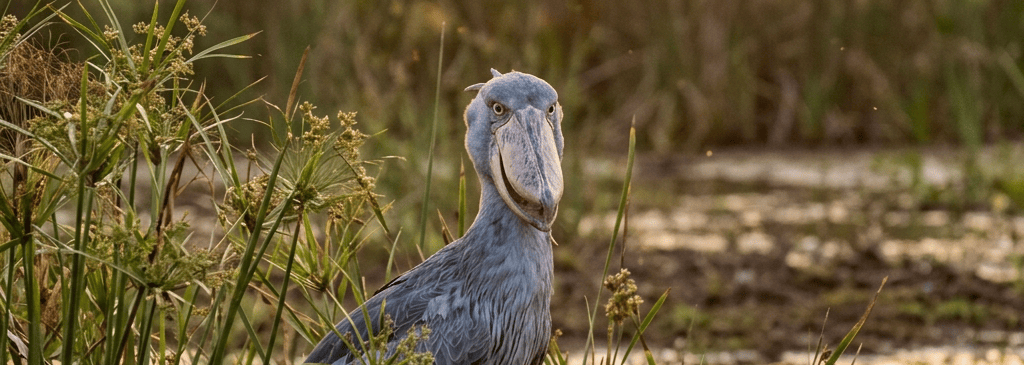

Should one say shehecheyanu on seeing a shoebill? Aside from the pleasing alliteration of this sentence, the concept became extremely relevant when, well, I saw a shoebill. But why would one say this blessing? Let’s understand each element here.
First, the shoebill. It is often called a shoebill stork, which is incorrect but an extremely useful way to describe it.
“I’m going to Bangweulu Wetlands,” I told everyone.
Where?
“Northernish Zambia. To see the shoebill.”
“The what?”
A Strange Beauty
When we think about our usual, idealised concepts of beauty, we may have trouble explaining the shoebill. A strange bird in all senses, it has been described as “demonic” by some, and “whimsical” by others. Compared to the colourful lilac-breasted roller, or magnificent crowned crane, it defies the usual definition of avian beauty, and it is also very difficult to access, to see with one’s own eyes, thus combining two features we have described in these pages. If we never see it, is it beautiful? And can the definition of beauty encompass a being that defies that definition?
The shoebill is often called a stork as it has stork-like features – standing 1.5 metres tall, it has long legs with elongated, scaled toes (so that it can tiptoe delicately on floating vegetation) and a fairly long neck. But it is no stork, belonging, as its scientific name indicates, to its own family: Balaeniceps rex is sui generis. The species name indicates the surprise scientists felt at seeing its head – balaena in Latin means “whale” and caput is head so that it is a “whale-headed king.” The English name is equally one of surprise as its enormous beak looks like a large Dutch clog. There are not many birds that people seem to feel the need to anthropomorphise, to attribute moral intention to, but the shoebill is one, with descriptions such as “prehistoric-looking” or “Large, somewhat frightful looking birds”[1] Even the Oxford Dictionary of Scientific Bird Names[2] cannot resist: “Balaeniceps: L. balaena, a whale; –ceps, headed; ref. the grotesque head-shape and huge bill of the Shoebill.”
Well, I’ve seen it and I beg to differ.
Admittedly, its head is larger than expected, its bill bigger than most, well-bred storks, who seem to follow the rules of beak sizes and shapes. The “break” in the beak also curves upwards, giving it a grin that is seen as sardonic at best, evil at worst by many, while its yellow eyes, again unusual for birds, are considered to have an intense and discomforting glare.
Or one can see the bird’s bill as being perfectly developed for fishing as it stands motionless for hours until an unwary lungfish unwarily to the surface of the channel waters, then – wham! – the shoebill lunges and grabs. The loud hammering sound it makes with that beak, jarring to a mere human ear, is to greet its hungry chick waiting its next meal eagerly as it approaches the nest.[3]
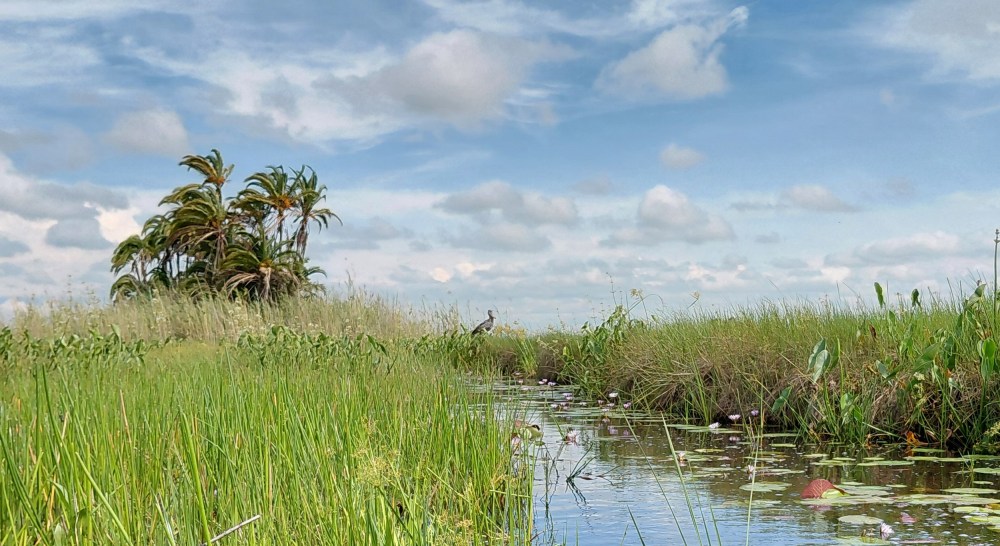
But when you see it for yourself, with your own eyes, it’s possible that you won’t think this. When I finally beheld one, I too anthropomorphised, seeing a whimsical grin and intelligent eyes that seemed to wink at me, sliding their nictitating membranes sideways with a brief white flash. They seemed to welcome me into their beingness, aware of the cosmic joke that had brought them into being.
The shoebill then begs the question: is it objectively beautiful or is it beautiful just by existing? And is it beautiful if we have never seen it? To both I was privileged to find an answer.
Because to see the shoebill, you must really, really want to. This phrase went through my head repeatedly as we jolted our way along sandy, muddy road-like smears in the miombo woodlands in northern Zambia. Shoebills are only found in a few countries in east-central Africa in remote papyrus-covered swamps. With only 5,000 remaining, they are listed as Vulnerable and Declining on the IUCN Red List, as their habitat is destroyed and even in protected areas their nests are in danger from fires, often set by fishers, that roar through the dry papyrus reeds in the dry season.
The journey to the shoebill is truly Livingstonian in the effort it takes. This is no coincidence as the area I was heading to is where the great explorer David Livingstone died on 1 May 1873, near the edge of the Bangweulu Swamps; one can visit a memorial that marks the spot. I flew to Lusaka, stayed overnight and then rode with Keagan, a local Bangweulu man and superb driver, for 10 hours along roads that sometimes defied the name and were almost always clogged with huge trucks making their way to or from neighbouring Democratic Republic of Congo or Tanzania.[4] After 400 kilometres of houses, villages and fields, we entered the Bangweulu Game Management Area where its people live alongside animals as they have done for generations. There, the air was clear of smog, but filled with the buzzing, crooning and whizzing of thousands of different insects, while the blue-blue sky with towering cumulous clouds building up for the afternoon thundershower peeked through the dazzling green of the woodland trees.
The next morning was another four o’clock wakeup to get to the particular area of the swamps where many of the 200 shoebills of Bangweulu live. Again, for over two hours, we bumped and jarred along sandy tracks, past thatched huts; occasionally one had a solar panel so that they could recharge a phone. At every gathering of huts, children of all shapes and sizes came running out to wave enthusiastically at us.
Stopping to pick up a mokoro (a fibreglass dugout canoe) and a quick coffee, off we jostled and joggled again for another half hour before the ground became muddy and the papyrus reeds rose and rustled just ahead of us. I got into the mokoro carefully and Louis paddled us out through the still waters of a channel. We were sliding around a curve in the channel when just ahead of me, a dark shape suddenly arose, like a blue-grey ungainly phoenix, out of a mess of flattened reeds. There he stood up straight, looking down his beak, his yellow eye gazing at us.
The shock – the sheer wonder at the fact of his existence! It welled up so fast from my gut and into my heart, expelled in an explosive “Oh, there you are!” and then, before I could think, the words for the blessing Shehechyanu swept off my tongue. (Earning a stern shhh from Louis; no disturbing the bird.) The whirligig of the world, the noise and strident voices, the complexities of human life – all of it stopped as we sat and the shoebill stood, occasionally ruffling its feathers, or rubbing that beak around its wing, the sigh of the wind through the dry reeds an appropriate undertone to the encounter. Despite my attempts to be scientific, that nictitating membrane definitely winked at me as he stood and grinned.
I didn’t notice the jolting jarring way home or the splatter of raindrops on my face. I was suspended in wonder. I have mentioned my favourite quote by R Sacks, that “God delights in diversity.” I think God is truly delighted with the shoebill. In my mind’s eye, the shoebill is also delighted, overjoyed at its own unique, strange and daring self.

By Olaf Oliviero Riemer, CC BY-SA 3.0, https://commons.wikimedia.org/w/index.php?curid=18375332
[1] https://animaldiversity.org/accounts/Balaeniceps_rex/ Accessed 23 Dec. 25
[2] Jobling, J. A Dictionary of Scientific Bird Names, Oxford University Press 1991, p. 26
[3] Hence its name in Bemba: The one who hammers.
[4] Of course, one could charter a flight but that would spoil the story.


